
Category: Marketing Automation

Explore the latest Marketing Automation strategies, trends, tools, and best practices to streamline marketing activities and improve business performance. This category covers automated email campaigns, lead generation, lead nurturing, customer segmentation, CRM integration, AI-powered automation, social media automation, workflow management, personalization, and performance analytics. Discover practical tips, expert insights, and proven techniques to save time, increase productivity, improve customer engagement, generate quality leads, boost conversions, and achieve sustainable business growth through effective marketing automation.

  • Digital Marketing for Small Businesses: How to Win Customers Without Outspending Big Brands

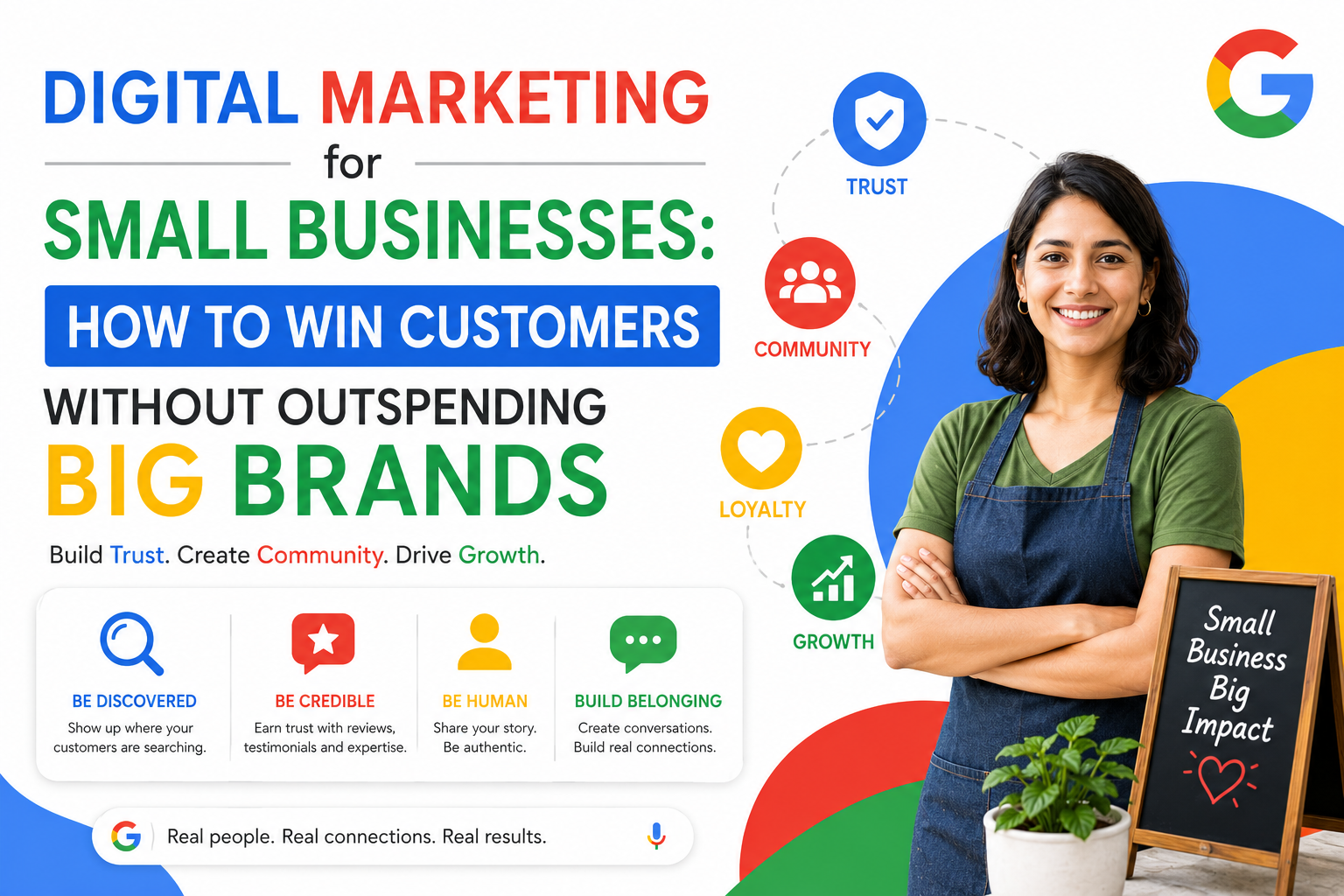
    Digital Marketing for Small Businesses: How to Win Customers Without Outspending Big Brands

    In today’s highly competitive digital marketplace, small businesses often find themselves competing against brands with larger advertising budgets, bigger teams, stronger distribution networks, and greater online visibility.

    At first glance, this may seem like an uneven competition.

    But small businesses have one advantage that large organizations often struggle to replicate: the ability to build genuine relationships with customers.

    Customers do not always choose the business that advertises the most. Increasingly, they choose brands they trust, understand, relate to, and feel connected with.

    This creates an important opportunity for small businesses. Instead of trying to outspend larger competitors, they can compete by becoming more human, more authentic, and more connected to their customers.


    Trust Is Becoming a Competitive Advantage

    Trust is one of the most valuable assets a small business can build.

    A customer may discover a company through Google, Instagram, Facebook, LinkedIn, YouTube, or an online advertisement. But discovery alone does not guarantee a purchase.

    Before making a decision, customers often look for signals that reduce uncertainty:

    • Customer reviews and testimonials
    • Recommendations from other people
    • Transparent pricing
    • Genuine communication
    • Helpful and informative content
    • Clear information about products or services
    • Consistent customer experiences
    • Evidence of expertise

    For a small business, these trust signals can become a powerful competitive advantage.

    Rather than simply saying, “We are the best,” a business should demonstrate why customers can confidently choose it.


    Stop Trying to Look Like a Big Brand

    One of the biggest mistakes small businesses can make is trying too hard to imitate large corporations.

    Large brands often have sophisticated advertising campaigns, professional production teams, celebrity endorsements, and enormous media budgets.

    A small business does not need to reproduce all of this.

    Its strength can be its personality.

    Customers may appreciate knowing the person behind the business, understanding its story, seeing how products are made, meeting the team, or hearing directly from the founder.

    This human connection can make a small business memorable.

    Authenticity does not mean being unprofessional. It means allowing customers to see the real people, values, expertise, and purpose behind the business.


    Build a Community, Not Just an Audience

    There is an important difference between an audience and a community.

    An audience consumes your content.

    A community participates, communicates, contributes, and develops a relationship with your brand and with other members.

    For example, a fitness business could simply publish exercise tips on social media. Or it could create a community where customers share their progress, ask questions, participate in challenges, and encourage one another.

    Similarly, a digital marketing consultancy could go beyond publishing marketing tips by creating webinars, discussion groups, Q&A sessions, workshops, newsletters, and networking opportunities.

    The objective is not simply to increase followers.

    The objective is to create a place where people feel that they belong.


    Give Customers a Reason to Participate

    Community does not develop automatically.

    Businesses need to create opportunities for participation.

    Some practical approaches include:

    1. Ask for opinions

    Ask customers what they think about a product, service, topic, or upcoming initiative.

    More importantly, demonstrate that their feedback has been heard.

    2. Encourage customer stories

    Invite customers to share how they use your product or how your service helped them solve a problem.

    Customer stories can become powerful forms of social proof.

    3. Create exclusive experiences

    Small businesses can offer webinars, workshops, early access, private groups, special resources, or educational sessions to their most engaged customers.

    The goal is not necessarily to offer discounts.

    Sometimes access and recognition are more valuable than price reductions.

    4. Celebrate your customers

    Feature customers on your website or social media channels, celebrate their achievements, and acknowledge their contributions.

    When customers feel recognized, their relationship with the business can become much stronger.


    Be Consistent Across Every Customer Touchpoint

    Trust is not created through one social media post or one excellent advertisement.

    It is built through repeated experiences.

    Think about every point where a potential customer interacts with your business:

    Search → Website → Social Media → Enquiry → Sales Conversation → Purchase → Customer Support → Follow-up

    Every interaction communicates something about your brand.

    If your website promises personal service but customers receive automated and impersonal responses, trust can quickly disappear.

    If your social media communicates transparency but your pricing is unclear, customers may become hesitant.

    If you promise fast support but take several days to respond, the gap between your promise and reality damages credibility.

    Therefore, small businesses should regularly review their entire customer journey.


    Content Should Help, Not Just Sell

    Another powerful way to build trust is through useful content.

    Instead of making every post promotional, businesses should answer the questions customers are already asking.

    For example, a financial consultant might publish:

    • How to prepare for tax season
    • Common financial mistakes
    • Questions to ask before choosing an investment
    • Simple explanations of financial terminology

    A digital marketing consultant might publish:

    • How Google Analytics works
    • How to improve local SEO
    • Common Google Ads mistakes
    • How to measure social media performance
    • How small businesses can use AI responsibly

    Such content demonstrates expertise before the customer ever makes a purchase.

    Over time, helpful content can position a small business as a trusted source of information.


    Reviews Are More Than a Rating

    Online reviews are particularly important for small businesses because they provide independent evidence of customer experience.

    Businesses should not simply collect reviews and forget about them.

    They should:

    • Ask satisfied customers for genuine reviews
    • Respond professionally to positive reviews
    • Respond constructively to negative reviews
    • Identify recurring issues
    • Use customer feedback to improve the business

    A negative review does not necessarily destroy trust.

    In some cases, the way a business responds to criticism can demonstrate transparency, accountability, and professionalism.


    Use Social Media to Start Conversations

    Social media should not become a digital billboard.

    If every post says “Buy now,” “Limited offer,” or “Contact us today,” customers have little reason to engage.

    Instead, businesses can use social platforms to start conversations.

    Ask questions.

    Share experiences.

    Respond to comments.

    Show behind-the-scenes activities.

    Introduce employees.

    Share customer success stories.

    Discuss industry developments.

    Invite customers to participate.

    The objective is to transform social media from a broadcasting channel into a relationship-building channel.


    Make Your Values Visible

    Customers increasingly want to understand what businesses stand for.

    This does not mean that every company needs a complicated corporate mission statement.

    It means being clear about the principles that influence the way the business operates.

    For example:

    • Do you prioritize customer service?
    • Do you support local suppliers?
    • Do you focus on sustainability?
    • Do you believe in accessibility?
    • Do you invest in employee development?
    • Do you provide transparent pricing?
    • Do you support a particular community?

    Values become meaningful when customers can see them reflected in everyday business decisions.


    Small Businesses Can Compete Without Winning the Advertising War

    A small business may never have the advertising budget of a multinational corporation.

    It may not dominate search results.

    It may not have millions of followers.

    It may not be able to compete with large brands on price.

    But it can compete on something much more difficult to scale:

    relationships.

    A founder can personally respond to a customer.

    A local business can know its community.

    A specialist can provide highly personalized advice.

    A small team can listen carefully and adapt quickly.

    These are not weaknesses.

    They can become strategic advantages.


    A Simple Trust-Building Framework for Small Businesses

    Small businesses can begin by reviewing five areas:

    1. Be Visible

    Make it easy for people to discover your business through search engines, social media, local listings, referrals, and useful content.

    2. Be Credible

    Demonstrate expertise through reviews, case studies, educational content, credentials, customer stories, and transparent information.

    3. Be Human

    Show the people behind the business. Share your story, personality, experiences, and values.

    4. Create Belonging

    Give customers opportunities to participate, communicate, contribute, and connect with others.

    5. Close the Feedback Loop

    Ask customers for feedback and, importantly, demonstrate what you did with it.

    When customers can see that their opinions influence the business, they are more likely to feel valued.


    The Future Belongs to Businesses People Trust

    Digital marketing has made it easier than ever for businesses to reach large audiences.

    But reaching people is not the same as building relationships with them.

    As content becomes easier to produce and advertising becomes increasingly competitive, trust can become one of the strongest differentiators available to small businesses.

    The winning strategy is therefore not always about reaching more people.

    Sometimes it is about creating deeper relationships with the people you already reach.

    Small businesses should stop asking:

    “How can we compete with their budget?”

    Instead, they should ask:

    “How can we become the business our customers trust, recommend, and want to be part of?”

    That shift, from competing on reach to competing on relationships, can turn a small business’s greatest limitation into one of its greatest strengths.

  • How AI Is Transforming Email Marketing: Strategies, Benefits, and Best Practices

    How AI Is Transforming Email Marketing: Strategies, Benefits, and Best Practices

    Email marketing has long been one of the most effective digital marketing channels for connecting with customers, nurturing leads, and driving conversions. However, changing customer expectations, growing competition, and the increasing volume of marketing messages have made traditional email marketing strategies less effective.

    Artificial Intelligence (AI) is changing this scenario.

    AI-powered email marketing enables businesses to understand their audiences better, personalize communication, automate campaigns, optimize delivery times, and improve overall marketing performance. Instead of sending the same message to thousands of subscribers, marketers can now create more relevant and personalized email experiences based on customer behaviour and preferences.


    What Is AI in Email Marketing?

    AI in email marketing refers to the use of artificial intelligence technologies, machine learning algorithms, predictive analytics, and automation tools to improve different aspects of an email marketing campaign.

    These technologies can analyse large amounts of customer data and identify patterns that may be difficult for marketers to discover manually. Based on these insights, AI can help marketers determine what content customers are interested in, when they are most likely to open an email, and what type of offer may encourage them to take action.

    As a result, businesses can make their email marketing campaigns more targeted, efficient, and data-driven.


    Why Is AI Becoming Important in Email Marketing?

    Consumers receive numerous promotional emails every day. Generic marketing messages often fail to attract attention because customers increasingly expect brands to understand their interests and preferences.

    AI helps businesses move from mass email communication towards more personalized customer experiences.

    By analysing customer interactions, purchase behaviour, browsing activity, and engagement patterns, AI-powered marketing tools can help businesses deliver the right message to the right customer at the right time.

    This approach can potentially improve email open rates, click-through rates, customer engagement, and conversions.


    1. AI-Powered Email Personalization

    Personalization is one of the most significant applications of AI in email marketing.

    Traditional email personalization often involves adding the subscriber’s name to the subject line or email content. AI takes personalization much further.

    AI systems can analyse customer data such as:

    • Previous purchases
    • Website browsing behaviour
    • Email engagement
    • Product preferences
    • Customer demographics
    • Interaction history

    Based on this information, businesses can create personalized email content and product recommendations for individual customers.

    For example, an e-commerce business can recommend products based on a customer’s previous purchases or browsing history. Similarly, an educational platform can suggest courses based on the learner’s interests and previous activities.

    Such personalized communication can make marketing emails more relevant and useful to customers.


    2. Creating Better Email Subject Lines with AI

    The subject line is one of the most important elements of an email marketing campaign. It can significantly influence whether recipients open or ignore an email.

    AI-powered tools can help marketers generate and optimize email subject lines.

    By analysing historical campaign performance, customer behaviour, and engagement patterns, AI can suggest subject lines that are more likely to attract the audience’s attention.

    Marketers can also use generative AI tools to create multiple variations of subject lines for testing.

    However, marketers should carefully review AI-generated suggestions to ensure that the subject lines remain accurate, relevant, and consistent with the brand’s communication style.


    3. Generating Email Content with Artificial Intelligence

    Generative AI has significantly changed the way marketers create content.

    AI-powered tools can assist marketers in creating:

    • Email headlines
    • Promotional messages
    • Product descriptions
    • Calls to action
    • Newsletter content
    • Follow-up emails
    • Welcome email sequences

    This can save considerable time, particularly for businesses that regularly manage multiple email campaigns.

    However, AI should ideally be used as a marketing assistant rather than a complete replacement for human creativity.

    Human review remains important for maintaining brand identity, emotional connection, factual accuracy, and communication quality.


    4. Smarter Audience Segmentation

    Audience segmentation is an essential component of successful email marketing.

    Traditionally, marketers segment customers based on basic information such as age, gender, location, or purchase history.

    AI can make segmentation significantly more sophisticated.

    Machine learning algorithms can analyse large volumes of customer data and identify groups of customers with similar behaviours, interests, and engagement patterns.

    Businesses can then create highly targeted email campaigns for these customer segments.

    For example, AI may help identify:

    • Customers likely to make another purchase
    • Subscribers who are becoming inactive
    • Customers interested in particular products
    • High-value customers
    • Customers likely to respond to promotional offers

    This allows marketers to create more relevant marketing communication for different audience groups.


    5. Predicting Customer Behaviour

    Predictive analytics is another powerful application of AI in email marketing.

    By analysing historical customer data, AI systems can identify patterns and predict possible future behaviour.

    For example, AI may help marketers estimate:

    • Which customers are likely to purchase a product
    • Which subscribers may unsubscribe
    • Which customers may become inactive
    • What products customers may be interested in
    • When customers may be ready to make another purchase

    These insights can help businesses develop proactive email marketing strategies.

    Instead of waiting for customers to take action, marketers can communicate with them at the most appropriate stage of their customer journey.


    6. Optimizing Email Send Times

    The timing of an email can significantly affect its performance.

    Customers have different habits when it comes to checking and responding to emails. Sending every email at the same time may therefore not produce the best results.

    AI-powered email marketing platforms can analyse individual engagement patterns and identify when subscribers are most likely to open and interact with emails.

    The system can then optimize email delivery times for different subscribers.

    This strategy can potentially increase engagement without requiring marketers to manually analyse the behaviour of every customer.


    7. Improving Marketing Automation

    Marketing automation has been an important part of email marketing for many years. AI is making these automation systems smarter and more responsive.

    Traditional email automation usually follows predetermined rules.

    For example:

    A customer subscribes to a newsletter → receives a welcome email → receives another email after three days → receives a promotional offer.

    AI-powered automation can make this process more dynamic.

    The system can analyse how customers interact with emails and modify communication based on their behaviour.

    For example, highly engaged customers may receive additional product information, while inactive subscribers may receive a re-engagement campaign.

    This creates a more personalized customer journey.


    8. AI-Powered A/B Testing

    A/B testing allows marketers to compare different versions of an email campaign.

    Marketers may test:

    • Subject lines
    • Email headlines
    • Images
    • Calls to action
    • Content
    • Promotional offers
    • Email layouts

    Traditional A/B testing can require significant time and manual analysis.

    AI can help automate and accelerate the testing process by analysing campaign performance and identifying successful variations.

    These insights can help marketers continuously improve their email marketing strategies.


    9. Improving Customer Engagement

    One of the primary objectives of email marketing is to build and maintain relationships with customers.

    AI can help businesses understand what type of content customers find valuable.

    By analysing customer engagement patterns, marketers can identify topics, products, offers, and communication styles that generate better responses.

    This information can be used to create more relevant email campaigns.

    When customers receive useful and personalized communication, they may be more likely to engage with the brand.


    10. Identifying and Re-Engaging Inactive Subscribers

    Subscriber inactivity is a common challenge in email marketing.

    Over time, some subscribers may stop opening emails or interacting with marketing campaigns.

    AI can help identify customers whose engagement levels are declining.

    Businesses can then create targeted re-engagement campaigns offering:

    • Personalized recommendations
    • Special offers
    • Useful content
    • Product updates
    • Feedback requests

    Early identification of declining customer engagement can help businesses take appropriate action before subscribers completely lose interest.


    Benefits of Using AI in Email Marketing

    Integrating AI into email marketing strategies can offer several benefits to businesses.

    Better Personalization

    AI enables businesses to create more relevant communication based on customer behaviour and preferences.

    Improved Marketing Efficiency

    Automation and AI-powered content creation can reduce the time required to manage email campaigns.

    Data-Driven Decision Making

    AI can analyse large volumes of marketing data and provide useful insights for campaign optimization.

    Better Customer Experiences

    Relevant and timely email communication can improve the overall customer experience.

    Improved Campaign Performance

    Better targeting, personalization, segmentation, and optimization may contribute to higher customer engagement and conversions.


    Challenges of Using AI in Email Marketing

    Despite its advantages, businesses should carefully consider the challenges associated with AI-powered email marketing.

    Data Privacy

    AI systems often require access to customer data. Businesses must ensure responsible data collection and comply with applicable privacy regulations.

    Data Quality

    AI-generated insights depend heavily on the quality of available data. Inaccurate or incomplete customer information may lead to ineffective marketing decisions.

    Over-Automation

    Excessive automation can make marketing communication feel impersonal.

    Businesses should maintain an appropriate balance between technology and human interaction.

    Accuracy of AI-Generated Content

    Generative AI tools can occasionally produce inaccurate or inappropriate content. Human review is therefore essential before publishing or sending AI-generated marketing communication.

    Best Practices for Using AI in Email Marketing


    Businesses planning to integrate AI into their email marketing strategies should follow a structured approach.

    Start by identifying specific marketing challenges that AI can help solve. Instead of implementing multiple AI technologies simultaneously, businesses can begin with areas such as content creation, personalization, segmentation, or campaign optimization.

    Maintaining high-quality customer data is equally important because AI systems rely on accurate information to generate meaningful insights.

    Marketers should also continuously monitor campaign performance and evaluate whether AI-powered strategies are producing the desired results.

    Most importantly, human creativity, strategic thinking, and ethical decision-making should remain central to the marketing process.


    The Future of AI in Email Marketing

    The role of artificial intelligence in email marketing is expected to continue expanding.

    Future AI-powered marketing systems may become increasingly capable of analysing customer behaviour, predicting individual preferences, generating personalized content, and optimizing customer journeys in real time.

    Email marketing may gradually move from traditional campaign-based communication towards intelligent, customer-centric conversations.

    However, the most successful organizations will likely be those that combine the analytical capabilities of AI with human creativity, strategic thinking, and an understanding of customer emotions.


    Conclusion

    Artificial Intelligence is transforming email marketing by making campaigns more personalized, automated, predictive, and data-driven.

    From generating email content and optimizing subject lines to predicting customer behaviour and improving audience segmentation, AI provides marketers with powerful opportunities to enhance their email marketing strategies.

    However, technology alone cannot guarantee marketing success.

    The effective use of AI requires quality data, appropriate marketing strategies, responsible data practices, continuous campaign optimization, and human oversight.

    Ultimately, the future of email marketing is not about replacing marketers with artificial intelligence. It is about enabling marketers to use AI effectively to understand their customers, create meaningful communication, and deliver better digital experiences.