Category: E-Commerce Marketing

Explore the latest E-Commerce Marketing strategies, trends, tools, and best practices to grow your online business and increase sales. This category covers e-commerce SEO, paid advertising, social media marketing, email marketing, content marketing, conversion rate optimization, customer retention, marketing automation, and AI-powered solutions. Discover practical tips, expert insights, and proven techniques to attract potential customers, improve the online shopping experience, increase conversions, and achieve sustainable growth in the competitive e-commerce marketplace.

  • What Are AI Agents? A Complete Beginner’s Guide for Marketers (2026)

    What Are AI Agents? A Complete Beginner’s Guide for Marketers (2026)

    Artificial Intelligence (AI) has rapidly transformed the marketing landscape. From content creation and customer service to campaign optimization and predictive analytics, AI-powered tools are helping businesses work smarter than ever before. Among the latest innovations, AI Agents are emerging as one of the most significant advancements in artificial intelligence.

    But what exactly is an AI Agent? How is it different from tools like ChatGPT or Gemini? More importantly, how can marketers leverage AI Agents to improve productivity, enhance customer experiences, and drive business growth?

    In this beginner-friendly guide, we’ll explain AI Agents in plain English, explore how they work, discuss their benefits and limitations, and show how they’re reshaping the future of marketing.


    What Is an AI Agent?

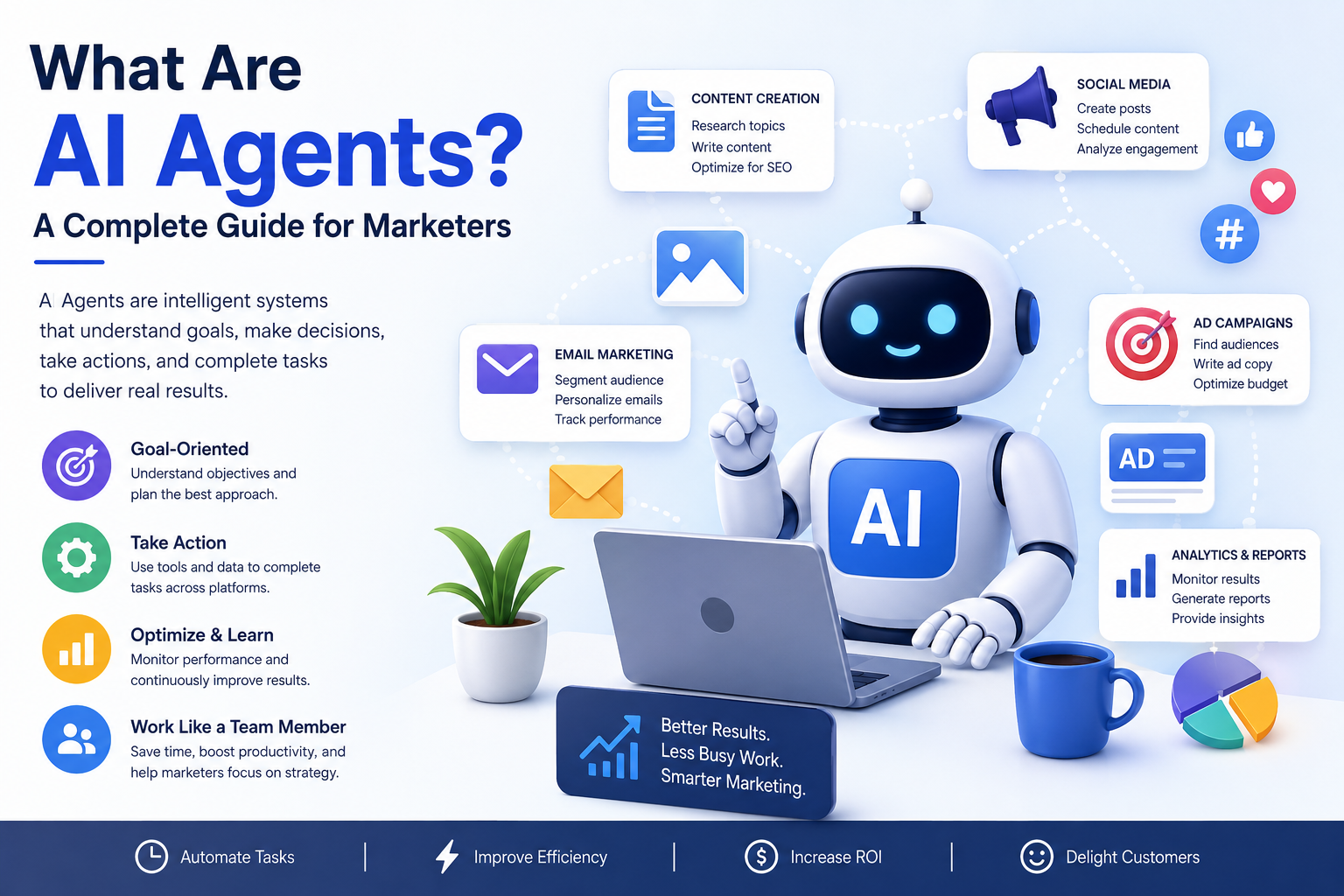
    An AI Agent is an intelligent software system designed to understand goals, make decisions, take actions, and complete tasks with minimal human intervention.

    Unlike a traditional AI chatbot that simply responds to prompts, an AI Agent can independently plan a sequence of actions, use different software tools, analyze results, and adapt its behavior to achieve a specific objective.

    Think of an AI Agent as a digital team member rather than just another AI tool.

    For example, if you ask an AI chatbot:

    “Write an email announcing our new product launch.”

    It will generate the email.

    However, if you instruct an AI Agent:

    “Launch our new product marketing campaign.”

    The AI Agent could:

    • Research your target audience.
    • Analyze competitors.
    • Create email campaigns.
    • Write blog articles.
    • Generate social media posts.
    • Design advertising copy.
    • Schedule content across multiple platforms.
    • Monitor campaign performance.
    • Recommend improvements based on real-time results.

    Instead of completing one isolated task, it manages an entire workflow.


    AI Agent vs AI Assistant: What’s the Difference?

    Many people confuse AI Agents with AI Assistants, but they serve different purposes.

    AI AssistantAI Agent
    Answers questionsAchieves goals
    Responds to promptsPlans and executes tasks
    Requires continuous instructionsWorks with minimal supervision
    Performs one task at a timeManages multi-step workflows
    Limited decision-makingMakes decisions within defined boundaries

    A simple way to remember the difference is:

    An AI Assistant helps you complete tasks.

    An AI Agent completes tasks for you.


    How Does an AI Agent Work?

    Although the technology behind AI Agents is complex, the overall process is easy to understand.

    1. Understands the Goal

    The user provides a high-level objective.

    Example:

    “Increase online sales by 25% during the festive season.”


    2. Creates a Plan

    The AI Agent divides the objective into smaller tasks such as:

    • Research customer behavior.
    • Analyze previous campaigns.
    • Identify target audiences.
    • Create marketing content.
    • Optimize advertising budgets.
    • Track campaign performance.

    3. Executes the Tasks

    Using integrated software and digital tools, the AI Agent performs the required actions.

    It may interact with:

    • Google Analytics
    • CRM platforms
    • Email marketing software
    • Social media scheduling tools
    • Advertising platforms
    • Content Management Systems (CMS)

    4. Monitors and Improves

    Unlike traditional automation, AI Agents continuously monitor performance.

    If one strategy isn’t producing the desired results, the Agent can recommend or implement adjustments to improve outcomes.

    This ability to learn and adapt makes AI Agents far more intelligent than standard automation tools.


    Why AI Agents Matter for Marketers

    Modern marketing involves hundreds of repetitive and data-driven activities.

    These include:

    • Writing blog posts
    • Creating social media content
    • Managing email campaigns
    • Running paid advertisements
    • Tracking website analytics
    • Monitoring customer engagement
    • Generating marketing reports
    • Managing leads

    AI Agents can automate many of these tasks, allowing marketers to spend more time on strategic planning, creativity, and customer relationship building.


    Real-World Applications of AI Agents in Marketing

    Content Marketing

    An AI Agent can:

    • Discover trending topics.
    • Perform keyword research.
    • Write SEO-optimized articles.
    • Create images.
    • Publish blog posts.
    • Monitor search rankings.
    • Suggest content updates.

    Social Media Marketing

    AI Agents can:

    • Generate engaging captions.
    • Create platform-specific posts.
    • Recommend hashtags.
    • Schedule posts automatically.
    • Analyze engagement metrics.
    • Identify the best posting times.

    Email Marketing

    AI Agents help marketers by:

    • Segmenting audiences.
    • Personalizing email campaigns.
    • Running A/B tests.
    • Monitoring open and click-through rates.
    • Optimizing future campaigns.

    Customer Support

    Instead of answering only basic questions, AI Agents can:

    • Understand customer intent.
    • Retrieve account information.
    • Process service requests.
    • Resolve common issues.
    • Escalate complex cases to human representatives.

    Digital Advertising

    AI Agents can:

    • Research target audiences.
    • Suggest keywords.
    • Generate ad copy.
    • Optimize campaign budgets.
    • Pause underperforming advertisements.
    • Increase investment in successful campaigns.

    Benefits of AI Agents

    Increased Productivity

    AI Agents automate repetitive work, allowing marketing teams to focus on innovation and strategy.

    Time Savings

    Tasks that previously required hours can often be completed within minutes.

    Better Personalization

    AI Agents analyze customer behavior to deliver highly personalized marketing experiences.

    Data-Driven Decisions

    By processing large volumes of information quickly, AI Agents help marketers make more informed decisions.

    Improved Campaign Performance

    Continuous monitoring enables AI Agents to optimize campaigns in real time, improving return on investment (ROI).


    Challenges and Limitations

    Despite their advantages, AI Agents also have limitations.

    Data Privacy

    Organizations must ensure customer data is handled responsibly and complies with applicable privacy regulations.

    Human Oversight

    AI-generated content and decisions should always be reviewed by humans, especially when they impact customers or brand reputation.

    Integration Challenges

    Connecting AI Agents with existing business systems may require technical expertise and careful planning.

    Dependence on Quality Data

    AI Agents are only as effective as the data and instructions they receive. Poor-quality inputs can lead to inaccurate outcomes.


    Are AI Agents Replacing Marketers?

    The simple answer is No.

    AI Agents are designed to enhance human productivity, not replace human creativity.

    Successful marketing still depends on:

    • Strategic thinking
    • Creative storytelling
    • Emotional intelligence
    • Brand positioning
    • Customer empathy
    • Ethical decision-making

    AI Agents excel at automation, analysis, and execution, while marketers provide vision, creativity, and leadership.

    The most successful organizations will combine human expertise with AI capabilities.


    The Future of AI Agents in Marketing

    As artificial intelligence continues to evolve, AI Agents will become an integral part of marketing teams.

    In the near future, businesses may employ specialized AI Agents for:

    • Search Engine Optimization (SEO)
    • Social Media Management
    • Content Marketing
    • Email Marketing
    • Paid Advertising
    • Customer Support
    • Market Research
    • Lead Generation
    • Marketing Analytics

    These intelligent systems will collaborate with human marketers, improving efficiency while enabling more personalized and data-driven customer experiences.


    Final Thoughts

    AI Agents represent the next generation of artificial intelligence in marketing.

    Unlike traditional AI tools that simply answer questions, AI Agents can understand objectives, create action plans, perform tasks across multiple platforms, analyze outcomes, and continuously improve their performance.

    For marketers, this means less time spent on repetitive work and more time dedicated to creativity, strategy, innovation, and customer engagement.

    As businesses increasingly adopt AI-powered technologies, understanding how AI Agents work will become an essential skill for marketing professionals. Those who embrace this technology thoughtfully will be better positioned to build stronger customer relationships, improve marketing performance, and remain competitive in the evolving digital landscape.

    Ultimately, the future of marketing isn’t about humans competing with AI. It’s about humans and AI Agents working together to achieve smarter, faster, and more impactful results.


    Frequently Asked Questions (FAQs)

    1. What is an AI Agent?

    An AI Agent is an intelligent software system that can understand goals, make decisions, perform tasks, and adapt its actions with minimal human intervention.

    2. How is an AI Agent different from ChatGPT?

    ChatGPT primarily responds to prompts and conversations, while an AI Agent can plan, execute, and monitor multi-step tasks using various tools to achieve a broader objective.

    3. Can AI Agents improve digital marketing?

    Yes. AI Agents can automate content creation, campaign management, customer support, analytics, lead nurturing, and advertising optimization, helping marketers improve efficiency and ROI.

    4. Will AI Agents replace marketing professionals?

    No. AI Agents are designed to support marketers by automating repetitive tasks, while humans continue to provide creativity, strategic thinking, ethical judgment, and relationship building.

    5. Should small businesses use AI Agents?

    Absolutely. AI Agents can help small businesses save time, reduce operational costs, improve customer engagement, and compete more effectively with larger organizations.

  • How Digital Marketing Can Help You Switch Careers

    How Digital Marketing Can Help You Switch Careers

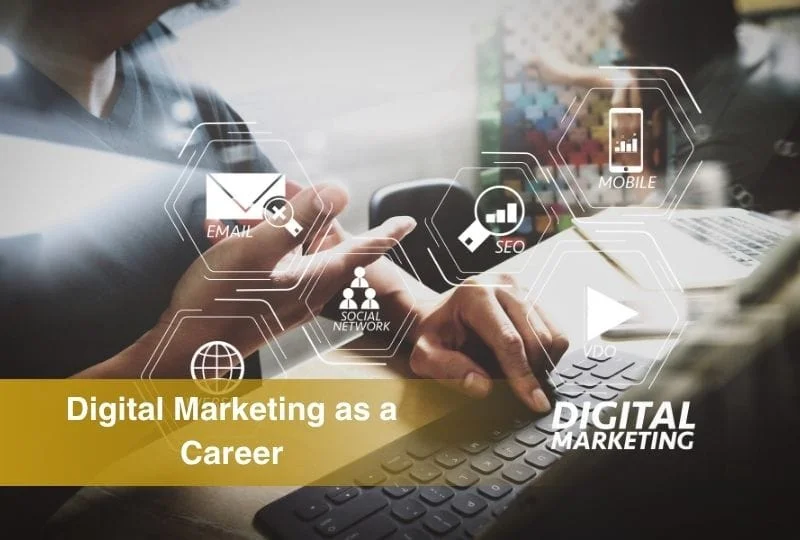
    Are you thinking about changing your career but unsure which field offers better opportunities for growth? A career in digital marketing could be an excellent option. With businesses increasingly using online platforms to attract customers, promote products, generate leads, and build brands, the demand for professionals with digital marketing skills continues to grow.

    One of the biggest advantages of switching careers to digital marketing is accessibility. Professionals from different educational and professional backgrounds can learn digital marketing and develop relevant skills. Whether you work in sales, education, finance, IT, management, customer service, or another industry, your existing experience can help you build a new career path in digital marketing.

    In this article, we explore how digital marketing can help you switch careers, which skills you need, the career opportunities available, and how you can start your journey.


    Why Choose Digital Marketing for a Career Change?

    Changing careers is an important professional decision. Before entering a new field, you need to consider career opportunities, required skills, learning time, growth potential, and long-term prospects.

    Digital marketing offers opportunities in several specialised areas, allowing professionals to choose a career path based on their interests, experience, and abilities.

    Unlike some traditional professions that require specific academic qualifications, digital marketing places considerable importance on skills, practical knowledge, creativity, analytical ability, and real-world experience.

    This makes digital marketing an attractive career option for professionals planning to enter a new industry.


    Can You Switch to a Career in Digital Marketing Without Previous Experience?

    Yes, it is possible to start a career in digital marketing without previous professional experience in the field.

    Digital marketing is a skill-based profession. While knowledge of marketing principles can be helpful, professionals from different industries can learn the tools and techniques required to work in digital marketing.

    The key is to combine theoretical knowledge with practical experience.

    You can begin by learning digital marketing fundamentals, creating your own website or blog, practising SEO, managing social media pages, exploring Google Ads, and learning how to analyse website performance using digital analytics tools.

    Practical learning can help you understand how digital marketing strategies work in real business situations.


    Your Existing Professional Skills Can Help You Build a Digital Marketing Career

    One of the biggest misconceptions about changing careers is that previous professional experience becomes irrelevant.

    In reality, your existing knowledge and skills can provide a significant advantage when you switch to digital marketing.

    For example, sales professionals often understand customers, communication, negotiation, and lead generation. These abilities can be valuable in performance marketing and digital sales.

    Teachers and trainers may have strong communication, presentation, and content development skills that can be useful in content marketing, online education, and social media marketing.

    IT professionals may find technical SEO, web analytics, website management, and marketing automation particularly interesting.

    Similarly, professionals with experience in finance, research, or data analysis may be well suited to areas such as web analytics, campaign measurement, and performance marketing.

    The most effective career transition strategy is to combine your previous professional experience with newly developed digital marketing skills.


    Explore Different Career Opportunities in Digital Marketing

    Digital marketing is not a single job. It is a broad professional field offering multiple career paths.

    Depending on your interests and abilities, you can explore opportunities in:

    • Search Engine Optimization (SEO)
    • Social Media Marketing
    • Content Marketing
    • Email Marketing
    • Google Ads and PPC Advertising
    • Web Analytics and GA4
    • E-Commerce Marketing
    • Affiliate Marketing
    • Marketing Automation
    • Artificial Intelligence in Digital Marketing
    • Digital Marketing Strategy
    • Online Branding and Reputation Management

    The availability of different specialisations makes a digital marketing career change suitable for professionals with diverse backgrounds.


    How to Choose the Right Digital Marketing Specialisation

    Choosing the right area of digital marketing is an important step when planning a career switch.

    Start by evaluating your interests, existing skills, and long-term career objectives.

    If you enjoy writing, research, and communication, SEO and content marketing may be suitable options.

    If you are creative and enjoy engaging with online communities, consider social media marketing.

    Professionals interested in advertising, campaign management, and business results may explore Google Ads and performance marketing.

    If you enjoy working with data and understanding customer behaviour, web analytics and GA4 could be suitable career paths.

    Those interested in emerging technologies can explore Artificial Intelligence, marketing automation, and AI-powered digital marketing tools.

    Selecting the right specialisation can help you focus your learning efforts and develop deeper professional expertise.


    Learn the Essential Digital Marketing Skills

    To successfully switch careers, you should begin by developing a strong understanding of digital marketing fundamentals.

    Important digital marketing skills include:

    • Search Engine Optimization
    • Keyword Research
    • Content Creation
    • Social Media Marketing
    • Google Ads
    • Email Marketing
    • Website Management
    • Google Analytics 4
    • Google Tag Manager
    • Marketing Automation
    • AI Tools for Digital Marketing
    • Campaign Planning and Measurement

    You do not need to master every area immediately.

    Start with the fundamentals and gradually specialise in one or two areas based on your interests and career goals.


    Gain Practical Digital Marketing Experience

    Practical experience is one of the most important factors in building a successful digital marketing career.

    Simply completing courses and certifications may not be enough. Employers and clients often want to see whether you can apply your knowledge to real projects.

    One of the best ways to gain experience is to create your own website or blog.

    You can practise keyword research, write SEO-friendly content, optimise web pages, create social media campaigns, explore email marketing, and analyse website traffic.

    You can also work on freelance assignments, volunteer projects, internships, or small business marketing projects.

    These experiences can help you build a strong digital marketing portfolio.


    Build a Digital Marketing Portfolio

    A professional portfolio can be particularly valuable for career switchers because it demonstrates your practical abilities.

    Your digital marketing portfolio may include:

    • Websites or blogs you have created
    • SEO projects
    • Keyword research reports
    • Content marketing campaigns
    • Social media strategies
    • Google Ads campaigns
    • Email marketing campaigns
    • Web analytics reports
    • Marketing dashboards
    • Digital marketing certifications

    A well-developed portfolio can help potential employers and clients understand your knowledge and capabilities.


    Earn Relevant Digital Marketing Certifications

    Professional certifications can strengthen your profile when switching to a digital marketing career.

    Certifications can demonstrate that you have invested time in learning industry tools, platforms, and marketing concepts.

    You can explore certifications related to Google Ads, Google Analytics, SEO, content marketing, email marketing, and social media marketing.

    However, certifications should be combined with practical experience.

    A certificate may demonstrate that you have completed a course, but your projects and portfolio demonstrate how effectively you can apply your knowledge.


    Build Your Professional Presence Online

    Your digital presence can play an important role in establishing your new professional identity.

    Start by optimising your LinkedIn profile and highlighting your digital marketing skills, certifications, projects, and professional experience.

    You can also publish articles, share industry insights, participate in professional discussions, and showcase your digital marketing projects.

    Creating a personal website or professional blog can further strengthen your credibility and help potential employers or clients discover your expertise.


    Start Your Career Transition Gradually

    You do not necessarily need to leave your existing profession immediately to begin a digital marketing career.

    A gradual transition can be a practical approach.

    Start learning digital marketing while continuing your current job. Work on personal projects, complete relevant certifications, develop your portfolio, and explore freelance opportunities.

    As your knowledge, practical experience, and professional network grow, you can begin applying for suitable digital marketing roles.

    This approach can make your career transition more structured and manageable.


    Career Opportunities After Learning Digital Marketing

    After developing relevant knowledge and practical skills, you can explore different professional opportunities.

    You may work as a:

    • Digital Marketing Executive
    • SEO Specialist
    • Social Media Manager
    • Content Marketing Specialist
    • PPC Specialist
    • Google Ads Specialist
    • Web Analytics Professional
    • Email Marketing Specialist
    • E-Commerce Marketing Professional
    • Digital Marketing Manager
    • Digital Marketing Consultant

    Experienced professionals may also explore freelancing, consulting, corporate training, entrepreneurship, and specialised digital marketing services.


    Is Digital Marketing a Good Career for Experienced Professionals?

    Digital marketing can be a suitable career option for experienced professionals because previous industry knowledge can become a competitive advantage.

    For example, a professional with experience in healthcare can specialise in healthcare digital marketing. Someone with experience in education can explore education marketing or EdTech. Similarly, professionals from retail, banking, tourism, real estate, and other industries can combine their sector knowledge with digital marketing expertise.

    This combination of industry experience and digital marketing skills can help professionals develop a specialised career profile.


    The Importance of Continuous Learning in Digital Marketing

    Digital marketing is constantly evolving.

    Search engine algorithms change, advertising platforms introduce new features, consumer behaviour develops, and Artificial Intelligence continues to influence marketing practices.

    Therefore, successful digital marketing professionals must remain committed to continuous learning.

    Reading industry blogs, attending webinars, completing professional courses, experimenting with new tools, and following industry developments can help you stay competitive.


    How Long Does It Take to Switch to a Digital Marketing Career?

    The time required to switch careers depends on your previous experience, learning ability, available time, and chosen specialisation.

    Some professionals may develop fundamental digital marketing skills within a few months, while building deeper expertise and practical experience can take longer.

    Instead of focusing only on how quickly you can change careers, focus on developing relevant skills and practical abilities.

    A well-planned and gradual career transition can create stronger long-term professional opportunities.


    Final Thoughts: Should You Switch to a Career in Digital Marketing?

    Digital marketing can provide an exciting career path for professionals looking for new opportunities, professional growth, flexibility, and continuous learning.

    One of its greatest advantages is the ability to combine your existing professional experience with new digital skills.

    To successfully switch to a career in digital marketing, start by learning the fundamentals, choose a suitable specialisation, gain practical experience, earn relevant certifications, build a professional portfolio, and establish your online presence.

    Changing careers requires time, effort, and continuous learning. However, with the right strategy and practical approach, digital marketing can open the door to diverse and rewarding career opportunities.


    Frequently Asked Questions About Switching Careers to Digital Marketing

    Can I switch to digital marketing without a marketing degree?

    Yes. Professionals from different educational and professional backgrounds can enter digital marketing. Practical skills, industry knowledge, certifications, and hands-on experience can help you build a career in the field.

    Is digital marketing suitable for professionals over 30 or 40?

    Yes. Age is not necessarily a barrier to entering digital marketing. Experienced professionals can combine their existing industry knowledge, management experience, and transferable skills with digital marketing expertise.

    Which digital marketing skill is best for a career change?

    The best skill depends on your interests and professional background. SEO, content marketing, social media marketing, Google Ads, web analytics, email marketing, and marketing automation are among the areas you can explore.

    Do I need technical skills to start a career in digital marketing?

    Advanced technical knowledge is not required for every digital marketing role. However, basic knowledge of websites, analytics, digital tools, and marketing technologies can be beneficial.

    How can I gain digital marketing experience before changing careers?

    You can create your own website or blog, work on personal projects, complete internships, take freelance assignments, volunteer for organisations, or help small businesses with their digital marketing activities.

    Can I work as a freelancer after learning digital marketing?

    Yes. Digital marketing offers opportunities for freelancing and consulting in areas such as SEO, social media marketing, content creation, paid advertising, email marketing, and web analytics.