
Author: Dr. Pushpendra Khandelwal

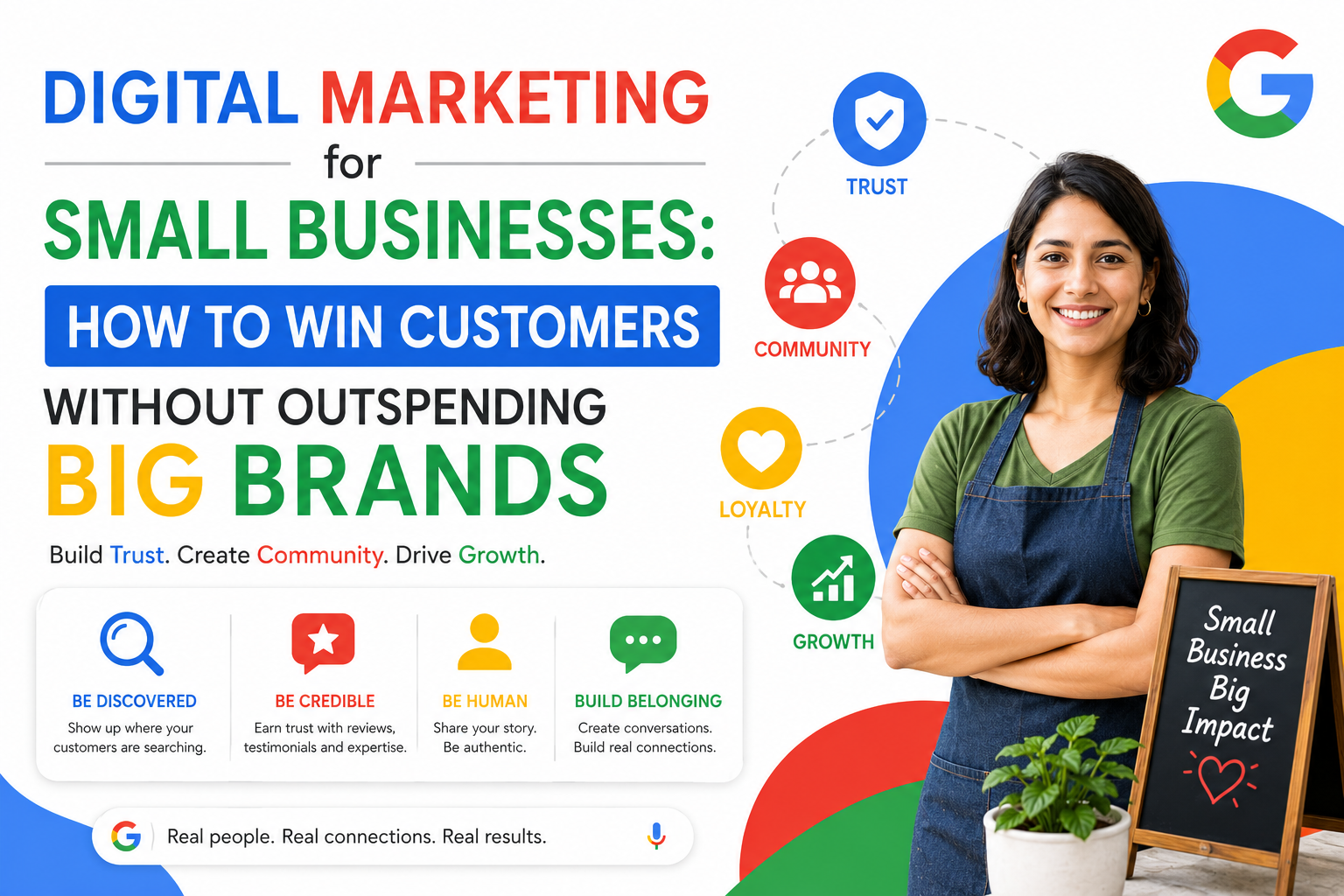
  • Digital Marketing for Small Businesses: How to Win Customers Without Outspending Big Brands

    Digital Marketing for Small Businesses: How to Win Customers Without Outspending Big Brands

    In today’s highly competitive digital marketplace, small businesses often find themselves competing against brands with larger advertising budgets, bigger teams, stronger distribution networks, and greater online visibility.

    At first glance, this may seem like an uneven competition.

    But small businesses have one advantage that large organizations often struggle to replicate: the ability to build genuine relationships with customers.

    Customers do not always choose the business that advertises the most. Increasingly, they choose brands they trust, understand, relate to, and feel connected with.

    This creates an important opportunity for small businesses. Instead of trying to outspend larger competitors, they can compete by becoming more human, more authentic, and more connected to their customers.


    Trust Is Becoming a Competitive Advantage

    Trust is one of the most valuable assets a small business can build.

    A customer may discover a company through Google, Instagram, Facebook, LinkedIn, YouTube, or an online advertisement. But discovery alone does not guarantee a purchase.

    Before making a decision, customers often look for signals that reduce uncertainty:

    • Customer reviews and testimonials
    • Recommendations from other people
    • Transparent pricing
    • Genuine communication
    • Helpful and informative content
    • Clear information about products or services
    • Consistent customer experiences
    • Evidence of expertise

    For a small business, these trust signals can become a powerful competitive advantage.

    Rather than simply saying, “We are the best,” a business should demonstrate why customers can confidently choose it.


    Stop Trying to Look Like a Big Brand

    One of the biggest mistakes small businesses can make is trying too hard to imitate large corporations.

    Large brands often have sophisticated advertising campaigns, professional production teams, celebrity endorsements, and enormous media budgets.

    A small business does not need to reproduce all of this.

    Its strength can be its personality.

    Customers may appreciate knowing the person behind the business, understanding its story, seeing how products are made, meeting the team, or hearing directly from the founder.

    This human connection can make a small business memorable.

    Authenticity does not mean being unprofessional. It means allowing customers to see the real people, values, expertise, and purpose behind the business.


    Build a Community, Not Just an Audience

    There is an important difference between an audience and a community.

    An audience consumes your content.

    A community participates, communicates, contributes, and develops a relationship with your brand and with other members.

    For example, a fitness business could simply publish exercise tips on social media. Or it could create a community where customers share their progress, ask questions, participate in challenges, and encourage one another.

    Similarly, a digital marketing consultancy could go beyond publishing marketing tips by creating webinars, discussion groups, Q&A sessions, workshops, newsletters, and networking opportunities.

    The objective is not simply to increase followers.

    The objective is to create a place where people feel that they belong.


    Give Customers a Reason to Participate

    Community does not develop automatically.

    Businesses need to create opportunities for participation.

    Some practical approaches include:

    1. Ask for opinions

    Ask customers what they think about a product, service, topic, or upcoming initiative.

    More importantly, demonstrate that their feedback has been heard.

    2. Encourage customer stories

    Invite customers to share how they use your product or how your service helped them solve a problem.

    Customer stories can become powerful forms of social proof.

    3. Create exclusive experiences

    Small businesses can offer webinars, workshops, early access, private groups, special resources, or educational sessions to their most engaged customers.

    The goal is not necessarily to offer discounts.

    Sometimes access and recognition are more valuable than price reductions.

    4. Celebrate your customers

    Feature customers on your website or social media channels, celebrate their achievements, and acknowledge their contributions.

    When customers feel recognized, their relationship with the business can become much stronger.


    Be Consistent Across Every Customer Touchpoint

    Trust is not created through one social media post or one excellent advertisement.

    It is built through repeated experiences.

    Think about every point where a potential customer interacts with your business:

    Search → Website → Social Media → Enquiry → Sales Conversation → Purchase → Customer Support → Follow-up

    Every interaction communicates something about your brand.

    If your website promises personal service but customers receive automated and impersonal responses, trust can quickly disappear.

    If your social media communicates transparency but your pricing is unclear, customers may become hesitant.

    If you promise fast support but take several days to respond, the gap between your promise and reality damages credibility.

    Therefore, small businesses should regularly review their entire customer journey.


    Content Should Help, Not Just Sell

    Another powerful way to build trust is through useful content.

    Instead of making every post promotional, businesses should answer the questions customers are already asking.

    For example, a financial consultant might publish:

    • How to prepare for tax season
    • Common financial mistakes
    • Questions to ask before choosing an investment
    • Simple explanations of financial terminology

    A digital marketing consultant might publish:

    • How Google Analytics works
    • How to improve local SEO
    • Common Google Ads mistakes
    • How to measure social media performance
    • How small businesses can use AI responsibly

    Such content demonstrates expertise before the customer ever makes a purchase.

    Over time, helpful content can position a small business as a trusted source of information.


    Reviews Are More Than a Rating

    Online reviews are particularly important for small businesses because they provide independent evidence of customer experience.

    Businesses should not simply collect reviews and forget about them.

    They should:

    • Ask satisfied customers for genuine reviews
    • Respond professionally to positive reviews
    • Respond constructively to negative reviews
    • Identify recurring issues
    • Use customer feedback to improve the business

    A negative review does not necessarily destroy trust.

    In some cases, the way a business responds to criticism can demonstrate transparency, accountability, and professionalism.


    Use Social Media to Start Conversations

    Social media should not become a digital billboard.

    If every post says “Buy now,” “Limited offer,” or “Contact us today,” customers have little reason to engage.

    Instead, businesses can use social platforms to start conversations.

    Ask questions.

    Share experiences.

    Respond to comments.

    Show behind-the-scenes activities.

    Introduce employees.

    Share customer success stories.

    Discuss industry developments.

    Invite customers to participate.

    The objective is to transform social media from a broadcasting channel into a relationship-building channel.


    Make Your Values Visible

    Customers increasingly want to understand what businesses stand for.

    This does not mean that every company needs a complicated corporate mission statement.

    It means being clear about the principles that influence the way the business operates.

    For example:

    • Do you prioritize customer service?
    • Do you support local suppliers?
    • Do you focus on sustainability?
    • Do you believe in accessibility?
    • Do you invest in employee development?
    • Do you provide transparent pricing?
    • Do you support a particular community?

    Values become meaningful when customers can see them reflected in everyday business decisions.


    Small Businesses Can Compete Without Winning the Advertising War

    A small business may never have the advertising budget of a multinational corporation.

    It may not dominate search results.

    It may not have millions of followers.

    It may not be able to compete with large brands on price.

    But it can compete on something much more difficult to scale:

    relationships.

    A founder can personally respond to a customer.

    A local business can know its community.

    A specialist can provide highly personalized advice.

    A small team can listen carefully and adapt quickly.

    These are not weaknesses.

    They can become strategic advantages.


    A Simple Trust-Building Framework for Small Businesses

    Small businesses can begin by reviewing five areas:

    1. Be Visible

    Make it easy for people to discover your business through search engines, social media, local listings, referrals, and useful content.

    2. Be Credible

    Demonstrate expertise through reviews, case studies, educational content, credentials, customer stories, and transparent information.

    3. Be Human

    Show the people behind the business. Share your story, personality, experiences, and values.

    4. Create Belonging

    Give customers opportunities to participate, communicate, contribute, and connect with others.

    5. Close the Feedback Loop

    Ask customers for feedback and, importantly, demonstrate what you did with it.

    When customers can see that their opinions influence the business, they are more likely to feel valued.


    The Future Belongs to Businesses People Trust

    Digital marketing has made it easier than ever for businesses to reach large audiences.

    But reaching people is not the same as building relationships with them.

    As content becomes easier to produce and advertising becomes increasingly competitive, trust can become one of the strongest differentiators available to small businesses.

    The winning strategy is therefore not always about reaching more people.

    Sometimes it is about creating deeper relationships with the people you already reach.

    Small businesses should stop asking:

    “How can we compete with their budget?”

    Instead, they should ask:

    “How can we become the business our customers trust, recommend, and want to be part of?”

    That shift, from competing on reach to competing on relationships, can turn a small business’s greatest limitation into one of its greatest strengths.

  • What Are AI Agents? A Complete Beginner’s Guide for Marketers (2026)

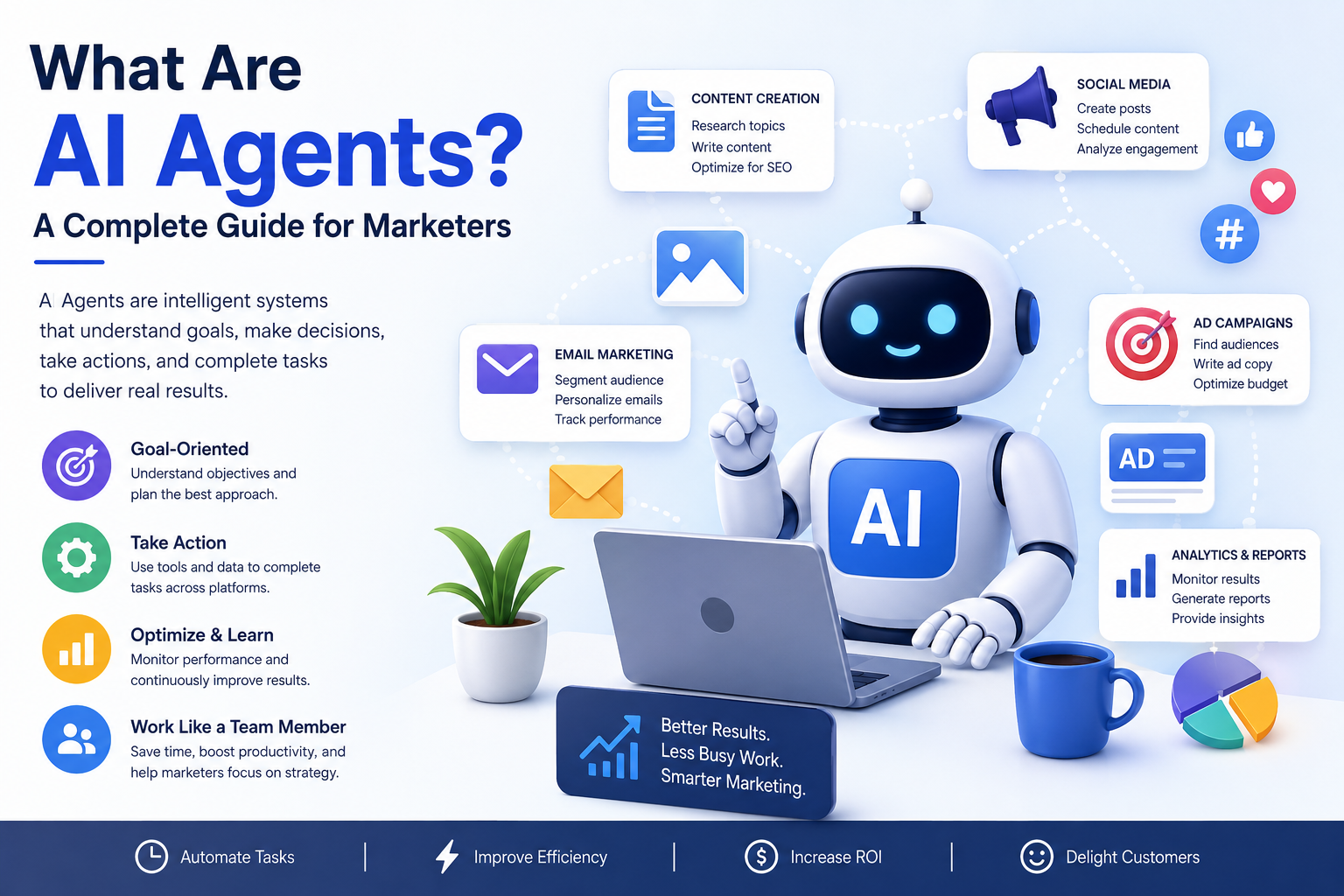
    What Are AI Agents? A Complete Beginner’s Guide for Marketers (2026)

    Artificial Intelligence (AI) has rapidly transformed the marketing landscape. From content creation and customer service to campaign optimization and predictive analytics, AI-powered tools are helping businesses work smarter than ever before. Among the latest innovations, AI Agents are emerging as one of the most significant advancements in artificial intelligence.

    But what exactly is an AI Agent? How is it different from tools like ChatGPT or Gemini? More importantly, how can marketers leverage AI Agents to improve productivity, enhance customer experiences, and drive business growth?

    In this beginner-friendly guide, we’ll explain AI Agents in plain English, explore how they work, discuss their benefits and limitations, and show how they’re reshaping the future of marketing.


    What Is an AI Agent?

    An AI Agent is an intelligent software system designed to understand goals, make decisions, take actions, and complete tasks with minimal human intervention.

    Unlike a traditional AI chatbot that simply responds to prompts, an AI Agent can independently plan a sequence of actions, use different software tools, analyze results, and adapt its behavior to achieve a specific objective.

    Think of an AI Agent as a digital team member rather than just another AI tool.

    For example, if you ask an AI chatbot:

    “Write an email announcing our new product launch.”

    It will generate the email.

    However, if you instruct an AI Agent:

    “Launch our new product marketing campaign.”

    The AI Agent could:

    • Research your target audience.
    • Analyze competitors.
    • Create email campaigns.
    • Write blog articles.
    • Generate social media posts.
    • Design advertising copy.
    • Schedule content across multiple platforms.
    • Monitor campaign performance.
    • Recommend improvements based on real-time results.

    Instead of completing one isolated task, it manages an entire workflow.


    AI Agent vs AI Assistant: What’s the Difference?

    Many people confuse AI Agents with AI Assistants, but they serve different purposes.

    AI AssistantAI Agent
    Answers questionsAchieves goals
    Responds to promptsPlans and executes tasks
    Requires continuous instructionsWorks with minimal supervision
    Performs one task at a timeManages multi-step workflows
    Limited decision-makingMakes decisions within defined boundaries

    A simple way to remember the difference is:

    An AI Assistant helps you complete tasks.

    An AI Agent completes tasks for you.


    How Does an AI Agent Work?

    Although the technology behind AI Agents is complex, the overall process is easy to understand.

    1. Understands the Goal

    The user provides a high-level objective.

    Example:

    “Increase online sales by 25% during the festive season.”


    2. Creates a Plan

    The AI Agent divides the objective into smaller tasks such as:

    • Research customer behavior.
    • Analyze previous campaigns.
    • Identify target audiences.
    • Create marketing content.
    • Optimize advertising budgets.
    • Track campaign performance.

    3. Executes the Tasks

    Using integrated software and digital tools, the AI Agent performs the required actions.

    It may interact with:

    • Google Analytics
    • CRM platforms
    • Email marketing software
    • Social media scheduling tools
    • Advertising platforms
    • Content Management Systems (CMS)

    4. Monitors and Improves

    Unlike traditional automation, AI Agents continuously monitor performance.

    If one strategy isn’t producing the desired results, the Agent can recommend or implement adjustments to improve outcomes.

    This ability to learn and adapt makes AI Agents far more intelligent than standard automation tools.


    Why AI Agents Matter for Marketers

    Modern marketing involves hundreds of repetitive and data-driven activities.

    These include:

    • Writing blog posts
    • Creating social media content
    • Managing email campaigns
    • Running paid advertisements
    • Tracking website analytics
    • Monitoring customer engagement
    • Generating marketing reports
    • Managing leads

    AI Agents can automate many of these tasks, allowing marketers to spend more time on strategic planning, creativity, and customer relationship building.


    Real-World Applications of AI Agents in Marketing

    Content Marketing

    An AI Agent can:

    • Discover trending topics.
    • Perform keyword research.
    • Write SEO-optimized articles.
    • Create images.
    • Publish blog posts.
    • Monitor search rankings.
    • Suggest content updates.

    Social Media Marketing

    AI Agents can:

    • Generate engaging captions.
    • Create platform-specific posts.
    • Recommend hashtags.
    • Schedule posts automatically.
    • Analyze engagement metrics.
    • Identify the best posting times.

    Email Marketing

    AI Agents help marketers by:

    • Segmenting audiences.
    • Personalizing email campaigns.
    • Running A/B tests.
    • Monitoring open and click-through rates.
    • Optimizing future campaigns.

    Customer Support

    Instead of answering only basic questions, AI Agents can:

    • Understand customer intent.
    • Retrieve account information.
    • Process service requests.
    • Resolve common issues.
    • Escalate complex cases to human representatives.

    Digital Advertising

    AI Agents can:

    • Research target audiences.
    • Suggest keywords.
    • Generate ad copy.
    • Optimize campaign budgets.
    • Pause underperforming advertisements.
    • Increase investment in successful campaigns.

    Benefits of AI Agents

    Increased Productivity

    AI Agents automate repetitive work, allowing marketing teams to focus on innovation and strategy.

    Time Savings

    Tasks that previously required hours can often be completed within minutes.

    Better Personalization

    AI Agents analyze customer behavior to deliver highly personalized marketing experiences.

    Data-Driven Decisions

    By processing large volumes of information quickly, AI Agents help marketers make more informed decisions.

    Improved Campaign Performance

    Continuous monitoring enables AI Agents to optimize campaigns in real time, improving return on investment (ROI).


    Challenges and Limitations

    Despite their advantages, AI Agents also have limitations.

    Data Privacy

    Organizations must ensure customer data is handled responsibly and complies with applicable privacy regulations.

    Human Oversight

    AI-generated content and decisions should always be reviewed by humans, especially when they impact customers or brand reputation.

    Integration Challenges

    Connecting AI Agents with existing business systems may require technical expertise and careful planning.

    Dependence on Quality Data

    AI Agents are only as effective as the data and instructions they receive. Poor-quality inputs can lead to inaccurate outcomes.


    Are AI Agents Replacing Marketers?

    The simple answer is No.

    AI Agents are designed to enhance human productivity, not replace human creativity.

    Successful marketing still depends on:

    • Strategic thinking
    • Creative storytelling
    • Emotional intelligence
    • Brand positioning
    • Customer empathy
    • Ethical decision-making

    AI Agents excel at automation, analysis, and execution, while marketers provide vision, creativity, and leadership.

    The most successful organizations will combine human expertise with AI capabilities.


    The Future of AI Agents in Marketing

    As artificial intelligence continues to evolve, AI Agents will become an integral part of marketing teams.

    In the near future, businesses may employ specialized AI Agents for:

    • Search Engine Optimization (SEO)
    • Social Media Management
    • Content Marketing
    • Email Marketing
    • Paid Advertising
    • Customer Support
    • Market Research
    • Lead Generation
    • Marketing Analytics

    These intelligent systems will collaborate with human marketers, improving efficiency while enabling more personalized and data-driven customer experiences.


    Final Thoughts

    AI Agents represent the next generation of artificial intelligence in marketing.

    Unlike traditional AI tools that simply answer questions, AI Agents can understand objectives, create action plans, perform tasks across multiple platforms, analyze outcomes, and continuously improve their performance.

    For marketers, this means less time spent on repetitive work and more time dedicated to creativity, strategy, innovation, and customer engagement.

    As businesses increasingly adopt AI-powered technologies, understanding how AI Agents work will become an essential skill for marketing professionals. Those who embrace this technology thoughtfully will be better positioned to build stronger customer relationships, improve marketing performance, and remain competitive in the evolving digital landscape.

    Ultimately, the future of marketing isn’t about humans competing with AI. It’s about humans and AI Agents working together to achieve smarter, faster, and more impactful results.


    Frequently Asked Questions (FAQs)

    1. What is an AI Agent?

    An AI Agent is an intelligent software system that can understand goals, make decisions, perform tasks, and adapt its actions with minimal human intervention.

    2. How is an AI Agent different from ChatGPT?

    ChatGPT primarily responds to prompts and conversations, while an AI Agent can plan, execute, and monitor multi-step tasks using various tools to achieve a broader objective.

    3. Can AI Agents improve digital marketing?

    Yes. AI Agents can automate content creation, campaign management, customer support, analytics, lead nurturing, and advertising optimization, helping marketers improve efficiency and ROI.

    4. Will AI Agents replace marketing professionals?

    No. AI Agents are designed to support marketers by automating repetitive tasks, while humans continue to provide creativity, strategic thinking, ethical judgment, and relationship building.

    5. Should small businesses use AI Agents?

    Absolutely. AI Agents can help small businesses save time, reduce operational costs, improve customer engagement, and compete more effectively with larger organizations.

  • What Is an SEO Consultant and Why Does Your Business Need One?

    What Is an SEO Consultant and Why Does Your Business Need One?

    Having a website is no longer enough to succeed online. With millions of websites competing for attention, businesses need effective strategies to improve their visibility on search engines, attract potential customers, and generate meaningful business results. This is where an SEO consultant can play an important role.

    An SEO consultant is a professional who helps businesses improve their online visibility through Search Engine Optimization (SEO). From analysing website performance and conducting keyword research to improving content, resolving technical issues, and developing long-term SEO strategies, an SEO consultant helps businesses strengthen their presence in organic search results.

    However, the role of an SEO consultant is changing rapidly. Today, SEO is no longer limited to ranking websites on traditional search engine results pages. The growth of Artificial Intelligence, AI Overviews, conversational search, and generative AI platforms is changing how people search for and discover information online.

    So, what exactly does an SEO consultant do, what services do they provide, and how can hiring one benefit your business?

    Let us explore.


    What Is an SEO Consultant?

    An SEO consultant is a digital marketing professional who specialises in improving the organic search visibility of websites.

    The primary objective of an SEO consultant is to help a website attract relevant organic traffic by improving its visibility for keywords and search queries used by potential customers.

    However, professional SEO consulting involves much more than simply adding keywords to web pages.

    An SEO consultant analyses different aspects of a website, including:

    • Website structure
    • Keyword targeting
    • Content quality
    • Technical performance
    • User experience
    • Backlink profile
    • Competitor strategies
    • Search engine rankings
    • Organic website traffic
    • Conversion opportunities
    • AI search visibility

    Based on this analysis, the consultant develops an SEO strategy aligned with the business objectives of the organisation.


    What Does an SEO Consultant Do?

    The responsibilities of an SEO consultant can vary depending on the nature of the business, industry competition, website size, and marketing objectives.

    However, most professional SEO consultants focus on improving three major areas of SEO:

    On-Page SEO

    On-page SEO involves optimising the content and elements available on individual website pages.

    Off-Page SEO

    Off-page SEO focuses on improving the authority and credibility of a website through activities outside the website.

    Technical SEO

    Technical SEO focuses on improving the technical structure and performance of a website so that search engines can efficiently discover, crawl, understand, and index its content.

    A professional SEO consultant combines these areas to develop a comprehensive search engine optimization strategy.


    What Services Does an SEO Consultant Provide?

    An SEO consultant may provide a wide range of services depending on the requirements of the business.

    Let us examine some of the most important SEO consulting services.


    1. SEO Website Audit

    An SEO audit is often the first step in developing an effective search engine optimization strategy.

    During an SEO audit, the consultant evaluates the overall performance of a website and identifies problems that may be affecting its search visibility.

    An SEO audit may examine:

    • Website structure
    • Indexing issues
    • Broken links
    • Page loading speed
    • Mobile responsiveness
    • Duplicate content
    • Meta titles and descriptions
    • Internal linking
    • Website security
    • Core Web Vitals
    • Backlink quality
    • Content performance

    The objective of an SEO audit is not simply to identify problems. A professional consultant should also recommend practical strategies to address those issues.


    2. Keyword Research and Search Intent Analysis

    Keyword research remains an important part of SEO.

    An SEO consultant identifies the words and phrases potential customers use when searching for information, products, or services online.

    However, effective keyword research is not simply about finding keywords with high search volumes.

    A consultant must also understand search intent.

    Search intent refers to the reason behind a user’s search query.

    For example, a person may be searching to:

    • Find information
    • Compare products or services
    • Visit a specific website
    • Make a purchase
    • Contact a service provider

    Understanding search intent helps businesses create content that better meets the needs and expectations of their target audience.


    3. On-Page SEO Optimization

    On-page SEO focuses on improving individual web pages to increase their relevance and visibility in search results.

    An SEO consultant may optimise:

    • Page titles
    • Meta descriptions
    • Heading structures
    • URLs
    • Images
    • Keywords
    • Content
    • Internal links
    • Calls to action

    Effective on-page SEO should improve both search engine visibility and user experience.

    Simply adding keywords repeatedly to a page is no longer an effective SEO strategy. Content must be useful, relevant, well-structured, and created around the needs of the target audience.


    4. Technical SEO

    A website may have excellent content, but technical problems can prevent it from performing effectively in organic search results.

    Technical SEO focuses on improving the technical foundation of a website.

    An SEO consultant may analyse:

    • Website speed
    • Mobile usability
    • Crawling and indexing
    • XML sitemaps
    • Robots.txt files
    • Canonical tags
    • HTTPS security
    • Structured data
    • Core Web Vitals
    • Website architecture
    • Redirects
    • Broken pages

    Technical SEO can be particularly important for large websites, e-commerce platforms, and websites that have undergone redesigns or migrations.


    5. SEO Content Strategy

    Content and SEO are closely connected.

    An SEO consultant may help businesses develop a content strategy designed to attract relevant audiences through organic search.

    This may include:

    • Identifying content opportunities
    • Conducting competitor content analysis
    • Creating topic clusters
    • Developing blog strategies
    • Identifying long-tail keywords
    • Updating existing content
    • Improving internal linking
    • Addressing content gaps

    The objective is to create useful content that answers audience questions while supporting the business’s marketing objectives.


    6. Competitor SEO Analysis

    Understanding competitors can provide valuable insights for developing an effective SEO strategy.

    An SEO consultant may analyse competitor websites to understand:

    • Which keywords they rank for
    • What type of content they publish
    • Where their backlinks come from
    • How their websites are structured
    • Which pages generate organic traffic
    • What SEO opportunities they may have overlooked

    Competitor analysis does not mean copying another company’s strategy.

    Instead, it helps businesses understand the competitive search environment and identify opportunities to develop a stronger SEO presence.


    7. Link Building and Off-Page SEO

    Backlinks can help search engines evaluate the credibility and authority of websites.

    However, not all backlinks provide equal value.

    An experienced SEO consultant focuses on developing high-quality and relevant links rather than simply generating a large number of backlinks.

    Off-page SEO strategies may include:

    • Digital PR
    • Guest contributions
    • Industry collaborations
    • Content promotion
    • Linkable content assets
    • Brand mentions
    • Relevant business directories

    The focus should always remain on quality, relevance, and credibility.


    8. Local SEO

    Local SEO is particularly important for businesses serving customers within specific geographical areas.

    An SEO consultant can help improve a business’s visibility for location-based searches.

    Local SEO activities may include:

    • Optimising Google Business Profile
    • Managing business information
    • Developing local keywords
    • Creating location-specific content
    • Building local citations
    • Managing online reviews

    An effective local SEO strategy can help businesses connect with potential customers searching for products and services in their geographical area.


    9. SEO Analytics and Performance Measurement

    SEO strategies should be based on data rather than assumptions.

    An SEO consultant uses analytics and search performance tools to monitor the effectiveness of SEO activities.

    Important SEO performance indicators may include:

    • Organic website traffic
    • Search visibility
    • Keyword rankings
    • Click-through rates
    • Engagement
    • Conversions
    • Leads
    • Revenue
    • Backlink growth

    Tools such as Google Analytics 4 and Google Search Console can provide valuable information about website and search performance.

    A professional SEO consultant should regularly analyse the data and modify strategies based on performance.


    10. SEO for AI Search and Generative Engines

    The search environment is changing rapidly with the growth of Artificial Intelligence.

    Users are increasingly discovering information through AI-powered search experiences, conversational platforms, and generative AI tools.

    As a result, businesses need to think beyond traditional search engine rankings.

    Modern SEO strategies may also consider:

    • AI Overviews
    • Generative Engine Optimization (GEO)
    • Answer Engine Optimization (AEO)
    • Conversational search
    • Entity optimization
    • Structured content
    • Brand authority
    • Content credibility

    An SEO consultant should understand how search behaviour is evolving and help businesses adapt their digital presence accordingly.


    What Skills Should a Professional SEO Consultant Have?

    SEO is a multidisciplinary field.

    A professional SEO consultant should possess a combination of technical, analytical, marketing, communication, and strategic skills.

    Important skills include:

    • Keyword research
    • Content optimization
    • Technical SEO
    • Website analytics
    • Competitor analysis
    • Link building
    • Search engine knowledge
    • Data interpretation
    • Problem-solving
    • Communication
    • Strategic planning
    • Understanding of AI-powered search

    SEO consultants must also continuously update their knowledge because search technologies and digital marketing practices continue to evolve.


    What Tools Does an SEO Consultant Use?

    SEO consultants use various tools to research, analyse, implement, and measure SEO strategies.

    Common categories of SEO tools include:

    • Keyword research tools
    • Website crawling tools
    • Backlink analysis platforms
    • Web analytics tools
    • Search performance tools
    • Competitor analysis tools
    • Website speed testing tools
    • AI-powered content research tools

    However, tools alone do not create successful SEO strategies.

    The real value of an SEO consultant lies in the ability to interpret data, identify problems, discover opportunities, and convert insights into practical business strategies.


    What Are the Benefits of Hiring an SEO Consultant?

    Hiring an SEO consultant can provide several advantages for businesses seeking to strengthen their online presence.

    Access to SEO Expertise

    SEO requires specialised knowledge and continuous learning. A consultant can provide professional expertise without requiring a business to build an entire in-house SEO department.

    Identification of Website Problems

    An experienced consultant can identify technical, content, and strategic issues that may be affecting website performance.

    Development of a Clear SEO Strategy

    Instead of implementing random SEO activities, a consultant can develop a structured strategy aligned with business objectives.

    Better Use of Marketing Resources

    An effective SEO strategy can help businesses focus their time and resources on activities that provide meaningful opportunities for growth.

    Improved Organic Search Visibility

    The primary objective of SEO consulting is to improve the ability of a website to reach relevant audiences through organic search.

    Data-Driven Decision Making

    SEO consultants use analytics and performance data to evaluate strategies and recommend improvements.


    When Should You Hire an SEO Consultant?

    Businesses may consider hiring an SEO consultant in several situations.

    For example, you may need professional SEO assistance when:

    • Your website is not generating sufficient organic traffic
    • Your search rankings are declining
    • You are launching a new website
    • You are redesigning or migrating your existing website
    • Your competitors are performing better in organic search
    • You do not have in-house SEO expertise
    • Your content is not generating expected results
    • You want to expand into new markets
    • You need a long-term organic growth strategy
    • You want to prepare your website for AI-driven search

    The right time to hire an SEO consultant depends on your business objectives and current digital marketing performance.


    SEO Consultant vs SEO Agency: What Is the Difference?

    Businesses often have to decide whether to work with an individual SEO consultant or hire an SEO agency.

    An SEO consultant generally provides more direct and personalised communication. Businesses may work closely with the consultant when developing and implementing strategies.

    An SEO agency usually has a larger team with professionals specialising in different areas, such as technical SEO, content development, link building, analytics, and digital strategy.

    The right choice depends on several factors, including:

    • Business size
    • Project complexity
    • Available budget
    • Required expertise
    • Internal resources
    • Marketing objectives

    Small and medium-sized businesses may benefit from the personalised approach of an experienced consultant, while large organisations with complex requirements may prefer the resources available through an agency.


    How to Choose the Right SEO Consultant

    Choosing the right SEO consultant is an important business decision.

    Before hiring a consultant, consider evaluating:

    • Professional experience
    • Knowledge of SEO
    • Understanding of your industry
    • Previous projects
    • Case studies
    • Client testimonials
    • Communication skills
    • Reporting methods
    • SEO strategy
    • Knowledge of analytics
    • Understanding of AI search developments

    You should also ask how the consultant measures SEO success.

    A professional consultant should be able to explain strategies clearly and connect SEO activities with meaningful business objectives.


    Red Flags to Avoid When Hiring an SEO Consultant

    Businesses should be cautious when evaluating SEO consultants.

    Some warning signs include:

    • Guaranteed first-page rankings
    • Promises of immediate SEO results
    • Lack of transparency
    • Unclear SEO methods
    • Poor communication
    • Focus only on rankings
    • Low-quality backlink strategies
    • No performance measurement
    • No understanding of business objectives

    SEO is a long-term process influenced by competition, website quality, content, technical performance, and changes in search technologies.

    Therefore, unrealistic guarantees should be treated with caution.


    How Much Does an SEO Consultant Cost?

    The cost of hiring an SEO consultant can vary considerably.

    Pricing may depend on:

    • Consultant experience
    • Project complexity
    • Website size
    • Industry competition
    • Required services
    • Project duration
    • Business objectives

    SEO consultants may charge hourly fees, monthly retainers, or project-based fees.

    Businesses should avoid selecting a consultant based only on the lowest price.

    Instead, consider the consultant’s experience, strategy, communication, transparency, and ability to understand your business objectives.


    Can an SEO Consultant Guarantee First-Page Rankings?

    No professional SEO consultant can ethically guarantee a specific first-page ranking.

    Search engine rankings are influenced by numerous factors, including competition, website quality, content relevance, backlinks, technical performance, user experience, and changes in search algorithms.

    A professional SEO consultant should focus on developing sustainable strategies that improve search visibility, attract relevant audiences, and contribute to business growth.


    Is Hiring an SEO Consultant Worth It?

    Hiring an SEO consultant can be a valuable investment when a business needs specialised expertise, strategic direction, and professional support to improve its online visibility.

    However, the effectiveness of SEO consulting depends on several factors.

    Businesses need realistic expectations, clear objectives, quality products or services, appropriate resources, and a willingness to implement recommended improvements.

    SEO is not simply about achieving higher rankings.

    An effective SEO strategy should help a business:

    • Reach relevant audiences
    • Improve website visibility
    • Build online credibility
    • Generate qualified traffic
    • Create better user experiences
    • Increase leads and conversions
    • Support long-term business growth

    The Future Role of SEO Consultants

    The role of an SEO consultant is evolving.

    Traditional SEO activities, such as keyword research, content optimization, technical SEO, and link building, remain important.

    However, SEO consultants increasingly need to understand:

    • Artificial Intelligence
    • AI-powered search
    • Generative Engine Optimization
    • Answer Engine Optimization
    • Search behaviour across multiple platforms
    • Data analytics
    • User experience
    • Brand authority
    • Content credibility

    The future SEO consultant will not simply focus on ranking web pages.

    Instead, SEO consulting will increasingly involve helping businesses improve their overall digital visibility across traditional search engines, AI-powered search experiences, and other digital discovery platforms.


    Final Thoughts: Does Your Business Need an SEO Consultant?

    An SEO consultant can help businesses understand their current search performance, identify opportunities for improvement, and develop strategies for sustainable online growth.

    From SEO audits and keyword research to technical optimization, content strategy, competitor analysis, analytics, and AI search visibility, an experienced consultant can provide valuable strategic direction.

    However, choosing the right SEO consultant requires careful evaluation.

    Look for someone who understands SEO as part of a broader digital marketing strategy, communicates clearly, uses data to support recommendations, understands changing search technologies, and focuses on meaningful business results rather than simply promising higher rankings.

    As search continues to evolve, businesses that invest in professional SEO strategies can be better prepared to improve their visibility, reach relevant audiences, and compete effectively in an increasingly complex digital environment.


    Frequently Asked Questions About SEO Consultants

    What exactly does an SEO consultant do?

    An SEO consultant analyses a website’s search performance and develops strategies to improve its organic visibility. Their work may include SEO audits, keyword research, technical SEO, content optimization, competitor analysis, link building, analytics, and AI search optimization.

    Do small businesses need an SEO consultant?

    Small businesses may benefit from an SEO consultant when they need professional assistance improving their online visibility but do not have sufficient in-house SEO expertise.

    How long does SEO take to show results?

    The time required to achieve SEO results varies depending on website condition, competition, industry, content quality, technical issues, and the SEO strategy implemented. SEO should generally be considered a long-term digital marketing activity.

    What is the difference between an SEO consultant and a digital marketing consultant?

    An SEO consultant primarily specialises in organic search visibility, while a digital marketing consultant may work across multiple areas, including SEO, social media marketing, paid advertising, email marketing, content marketing, analytics, and overall digital strategy.

    Can an SEO consultant help with AI search visibility?

    Modern SEO consultants increasingly need to consider how content and brands appear in AI-powered search experiences, answer engines, and generative AI platforms alongside traditional search results.

    Should I hire an SEO consultant or an SEO agency?

    The decision depends on your budget, project requirements, website size, and business objectives. An individual consultant may provide more personalised attention, while an agency may offer access to a larger team of specialists.